

Business
Business Intent 
As a department we aim to prepare our students to be tomorrow’s entrepreneurs, equipped and able to be successful in any challenge they encounter; through becoming independent life-long learners.
We aim to enable every Business Studies student to leave school with an accredited qualification and have high personal expectations. We strive to reduce the attainment gap between groups of students by making effective use of data to inform teaching and learning, by constantly developing our skills as a teaching team.
- Develop real life skills through demonstrating an understanding of the interrelated nature of business
- The ability to use business models, theories and techniques to support analysis of contemporary business issues
- Develop the knowledge and skills needed to analyse data, think critically about issues and apply theory to business situations
- Engage students through topics and issues that are relevant and topical in today’s society.
- The ability to think critically about issues and make informed decisions
- Students will develop critical thinking skills and enquiring attitudes
- Develop skills that will prepare students’ workplace skills which in turn will contribute to their economic wellbeing
- Nurture contextualises learning through the use of real life situations and problem-solving scenarios.
- Develop transferable skills and qualities such as the ability to work effectively in teams through effective communication.
Economics Intent
A Level Economics is an engaging and intellectually stimulating subject that explores how individuals, businesses, and governments make decisions in a world of scarce resources. It is particularly well suited to students considering future careers in Finance, Banking, Business Management, Public Policy, Data Analysis, and other related fields.
The course encourages students to think critically about real-world economic issues while developing strong analytical, quantitative, and evaluative skills. Through the study of both microeconomics and macroeconomics, students investigate a range of contemporary topics, including economic growth, inequality, globalisation, market structures, and government intervention. Throughout the course, students will:
- Develop an understanding of the interrelated nature of economic activities at local, national, and global levels.
- Apply economic models, theories, and concepts to analyse and evaluate contemporary economic issues.
- Build the knowledge and skills required to interpret data, analyse trends, and make informed judgements.
- Engage with relevant and topical issues such as inflation, unemployment, economic growth, inequality, globalisation, and environmental sustainability.
- Develop the ability to think critically about economic problems and evaluate different policy solutions.
- Cultivate enquiring minds through the investigation of real-world economic events and current affairs.
- Gain valuable quantitative, analytical, and problem-solving skills that are highly sought after by universities and employers.
- Enhance decision-making skills by examining how economic choices affect individuals, businesses, governments, and societies.
- Develop transferable skills, including communication, research, evaluation, and the ability to construct well-reasoned arguments supported by evidence.
By studying A Level Economics, students will develop a strong understanding of how economies operate and how economic decisions influence everyday life. The course strengthens analytical, numerical, and evaluative skills while encouraging independent thought and informed debate. These skills provide an excellent foundation for higher education and careers in Economics, Finance, Banking, Business, Public Policy, Data Analysis, Law, and many other professional fields.
What Will Students Study in Business Studies and in Economics?
View the Business Studies and Economics Learning Journey below
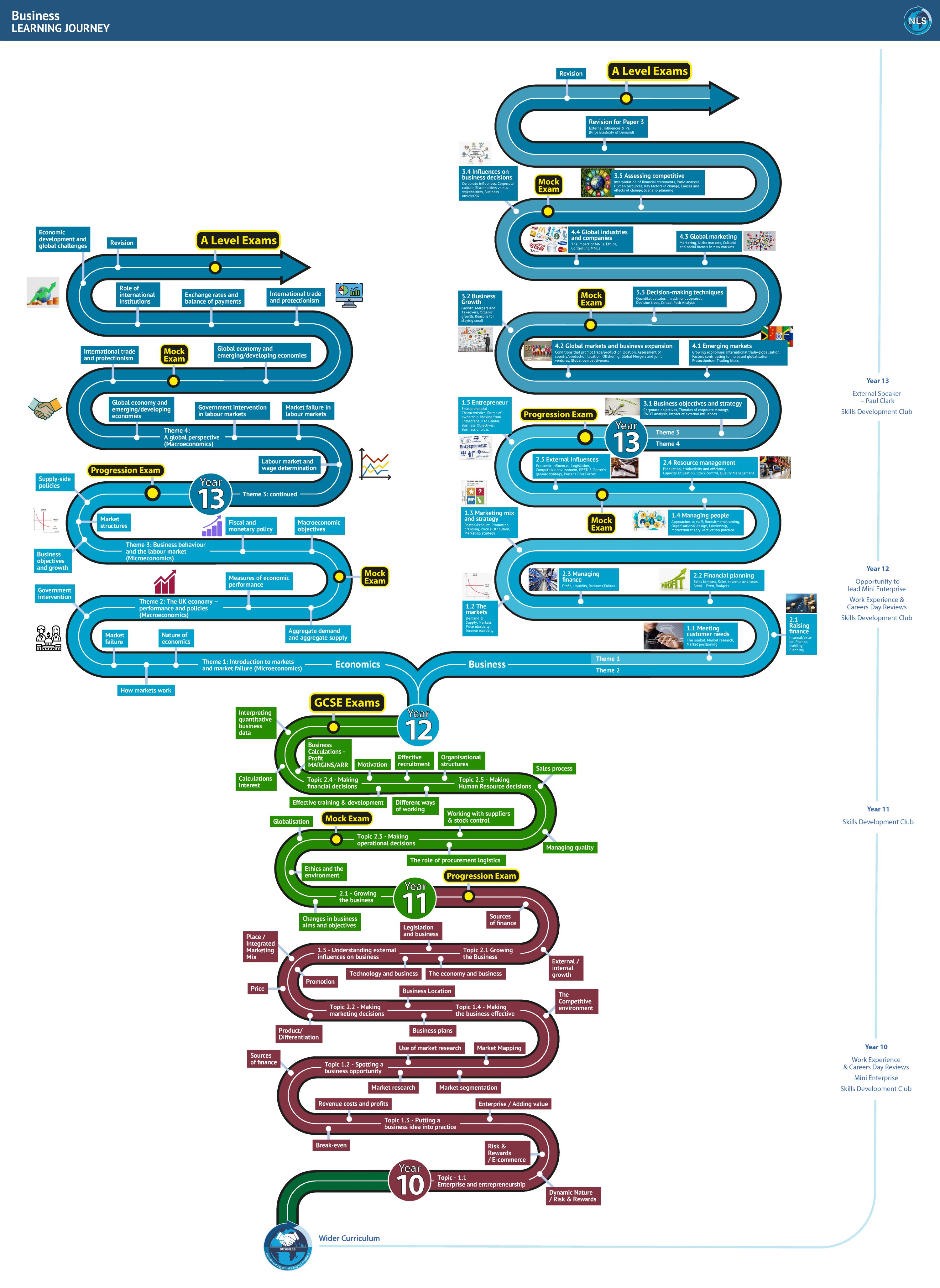
Curriculum overviews
Year 10 Business Curriculum Overview
Year 11 Business Curriculum Overview
Year 12 Business Curriculum Overview
Year 13 Business Curriculum Overview
Year 12 Economics Curriculum Overview
Year 13 Economics Curriculum Overview